In the past few years, if you wanted to target someone with a niche interest, you didn’t just do it based off what pages they like or engaged with, Facebook also used data collected by the Pixel or SDK to track websites and apps used outside of the social media platform.
With Facebook tracking users we suddenly had an audience of over a billion people worldwide to advertise to, that did not rely on search intent, and best of all we could target anyone with an interest in knitting at a fraction of the cost of advertising in a publication.
However, the release of Apple’s iOS 14 update will bring a halt to the full targeting capabilities we have grown used to and changes will affect how marketers receive and process conversion events from tools like, Facebook Pixel.
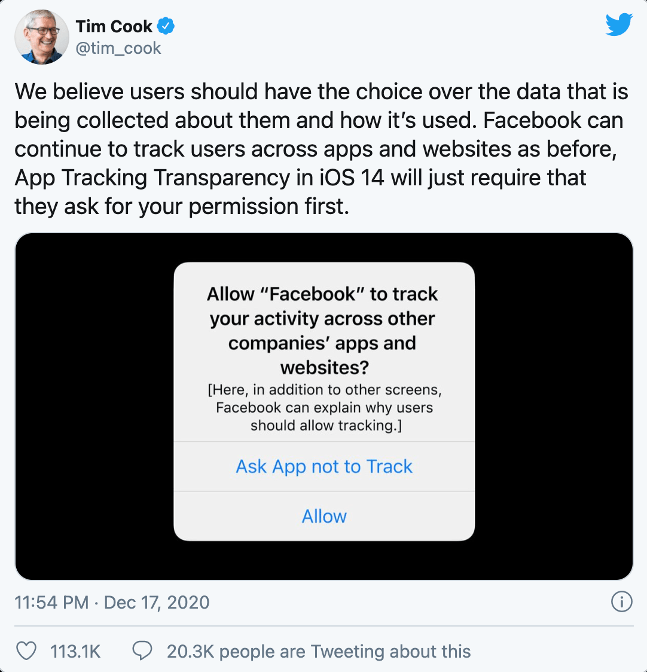
In June 2020, Apple launched iOS 14, with this latest mobile operating system, one of their biggest focuses was user privacy. As part of the development policy, Apple have introduced the requirement that all users must give permission to be tracked outside of the app they’re using, as well as offering the option of opting out of this tracking.
Although Facebook offers the ability to not be tracked, these settings are buried deep inside the privacy options where people are not aware of them or can not be bothered to go looking for them and thus Apple are enforcing a pop up to make users aware that they can “opt out”.
Now, I don’t know how many people will opt out of being tracked, however, as of December 80% of iPhones and iPads were running iOS 14 it has noticeably shook Facebook. So much so they have taken out several full page adverts in the US media attacking Apple and setting up a site where they are “Speaking up for small businesses” (https://www.facebook.com/business/apple-ios-14-speak-up-for-small-business)… or their own profits, I won’t judge.
Users will receive a prompt on their devices, if they opt out certain data collection and sharing will be prohibited. As more people opt out of tracking on iOS 14 devices, ads personalisation and performance reporting will be limited for both app and web conversion events.
Curtis Gabriel’s Senior Digital and Design Officer, Stuart Taylor shares his thoughts on the new privacy update, “Facebook will likely be making changes to how we advertise and receive results, it’s good to understand what these changes may be and how they may affect marketing campaigns. It is important to add, at this point, that this is not just about Facebook. The same message will appear on any app that has the ability to track user’s digital footprint outside of the respected app (think LinkedIn, Pinterest, YouTube).”
Audience
Firstly, let’s look at the audiences we advertise to. We are not going to lose the ability to create an audience during the Ad Set phase, however, the potential numbers of the metrics we chose to target are going to be smaller when we drill down into more detailed targeting (i.e. people who have an interest in…). It is this data that is gathered by tracking. Think about a time you have been looking at a holiday, for example, online and suddenly your Facebook timeline is flooded with tour operators advertising great deals to Sharm El-Sheikh.
Users opting out is not going to affect the overall number of how many people we are able to advertise to for our money though there is the potential that we will now target people with no interest in holidays.
Optimisation
Without data being recorded Facebook Ad Manager will not be able to effectively optimise to people who take action.
Results
Results we receive to Ad Manager are going to be delayed and based on an aggregate. Events received from the pixel and the SDK are going to be delayed for up to three days as these figures are calculated. With this, the conversion window is narrowing to 7 days click and 1 day view, meaning we will no longer be able to record a conversion up to 28 days after a user has clicked on an advert.
Retargeting
One of the most powerful aspects of any marketing funnel is the re-targeting phase. Without the ability to track a user we are unable to re-target them.
App Installs
For those who have the SDK implemented in an app the ability to record app downloads and app usage is going to take a hit.
Apple may have taken this approach as people are often weary and uncomfortable that their online movements are so widely tracked. However, smaller businesses who rely on this kind of targeting to market their products online, need not worry, the ‘untracking’ is in the early stages and there is plenty of time to adapt.
We do not know how many people will “opt out” of being tracked. As time goes on Facebook will make adjustments, based on their analytics, to best serve advertisers and at my current agency, Curtis Gabriel we already have solutions in place to ensure the ads we produce for clients are no less effective than prior to the privacy update.
But if think you might need a bit more help? That’s no problem!
Please don’t hesitate to drop me a message on LinkedIn if you have any questions regarding Facebook Ads or Paid Social in general, I promise I don’t bite!
 Hannah Lymn: Social Media Specialist